
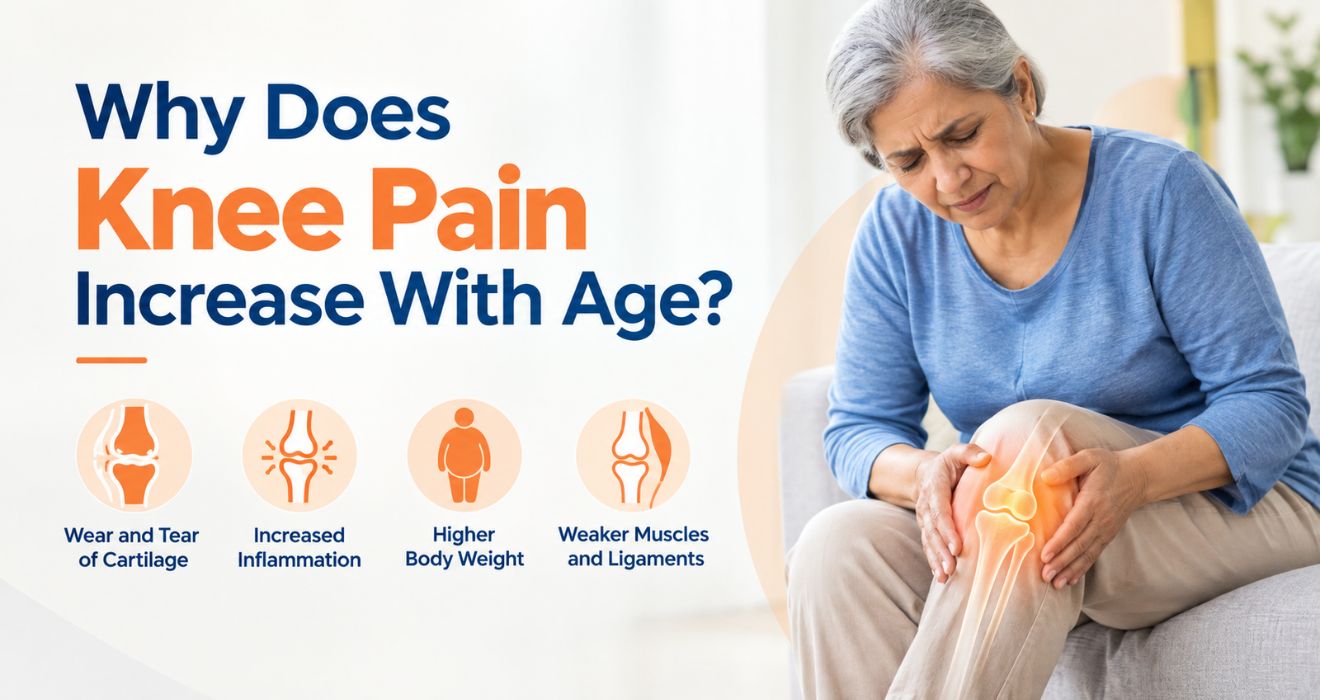
Why Does Knee Pain Increase With Age?
Have you noticed that your knees do not feel the way they used to a few years ago? Maybe getting up from a chair takes a little more effort, stairs are not as comfortable as before, or your knees start aching after a long walk. For many people, these changes become more noticeable as they enter their 40s and 50s and continue to increase with age.
Knee pain is common in older adults, but it is not caused by age alone. The knee is one of the most used joints in our body. Every day, it helps us walk, climb stairs, sit, stand, bend and carry our body weight. After years of doing all this, the structures inside the knee can gradually change. The cartilage may become thinner, the muscles around the joint may lose strength, and an old injury may start causing trouble again.
This is also why knee pain can be very different from one person to another. Two people may be the same age, but one may walk comfortably while the other struggles with stairs or needs support while getting up. The condition of the joint, previous injuries, body weight, physical activity and muscle strength all have a part to play.
What Happens to Your Knees as You Get Older?
To understand age-related knee pain, it helps to know a little about how the knee works. The ends of the bones inside the knee are covered with a smooth layer of cartilage. It allows the joint to move smoothly and helps reduce friction when the knee bends and straightens.
As the years pass, this cartilage can gradually become thinner and rougher. This does not usually happen overnight. It can take years before a person starts noticing symptoms. In the beginning, there may only be some stiffness after sitting for a long time or mild pain after a tiring day. Later, walking for a longer distance, climbing stairs or getting up from a low chair may become uncomfortable.
For some people, these changes are part of knee osteoarthritis. Osteoarthritis is one of the common causes of knee pain with age, but it is not the only one. An old ligament or meniscus injury, muscle weakness, changes in body weight and other joint problems can also contribute to pain.
This is why simply saying “my knees hurt because I am getting older” does not tell us what is really happening inside the joint.
Why Does Knee Pain Become More Common After 50?
There is a reason knee pain after 50 is such a common concern. By this age, the knees have already gone through many years of daily movement and load. If there has been an injury in the past, or if the muscles supporting the knee have become weaker, the joint may have less support than it once did.
Think about someone who has spent years climbing stairs every day, standing for long hours at work, playing sports or carrying extra body weight. The knee has been working through all of these activities for decades. It is not surprising that some people begin to notice pain or stiffness later in life.
Reduced activity can add to the problem as well. When people become less active because of work, lifestyle or other reasons, the muscles around the thighs and hips can gradually become weaker. These muscles help support the knee during movement. When they lose strength, everyday activities can feel more demanding on the joint.
Body weight is another factor worth considering. The knees carry a large amount of the load during walking and other daily movements. Extra weight can increase the stress on the joint and may make existing knee symptoms more difficult to manage. This does not mean that every person with knee pain has a weight-related problem. It is simply one of several factors that can affect knee health.
Why Do Simple Activities Start Hurting?
One of the first things patients often notice is that the pain is not necessarily present all the time. The knee may feel fine while resting but start hurting when it has to work harder.
Climbing stairs is a good example. So is getting up from a chair, sitting on the floor, squatting or getting out of a car. These movements require the knee and the muscles around it to work together under load. If the joint has become worn or the supporting muscles have weakened, these everyday activities may bring out the pain.
Some people also describe stiffness when they get up after sitting for a while. The first few steps may feel uncomfortable, and the knee may gradually loosen as they start moving. Others may notice swelling after walking or standing for a long time.
These symptoms can give an orthopedic doctor useful information, but they do not by themselves tell us the exact cause. A proper examination is needed to understand whether the problem is related to osteoarthritis, an old injury, muscle weakness, inflammation, alignment or something else.
Does Everyone Get Knee Pain With Age?
No. Growing older does not automatically mean that you will develop painful knees.
Age increases the chance of certain knee conditions, but people age differently. Some remain physically active and have very few knee problems, while others may develop significant pain earlier. Previous injuries, activity levels, body weight, muscle strength and even the way a person uses the joint over many years can make a difference.
This is also why regular knee pain should not simply be accepted as a normal part of ageing. If pain is becoming more frequent or is stopping you from doing things you enjoy, it deserves attention.
For example, if you have started avoiding stairs because of knee pain, walking shorter distances than before, or taking support every time you get up from a chair, your knee may be telling you that something needs to be checked.
Can You Keep Your Knees Healthy as You Age?
There is no way to stop the natural ageing of the body, but there are several things you can do to take better care of your knees.
Staying active is one of them. Regular movement helps maintain muscle strength and keeps the joints moving. Walking, cycling, swimming and suitable strengthening exercises can be part of a healthy routine for many people. However, if you already have knee pain, the exercise should match your condition. Pushing through severe pain is not the goal.
Keeping your body weight in a healthy range can also reduce the load placed on the knees. You do not need to make extreme changes. Consistent habits involving physical activity and a balanced diet are more useful in the long run.
It is also worth paying attention to old knee injuries. An injury from years ago may not have caused problems for a long time, but recurring pain or swelling should not be ignored. If something has changed, the knee may need to be assessed again.
Most importantly, do not stop moving completely because you are afraid of knee pain. In many cases, the right type of movement is actually an important part of managing knee problems.
When Is It Time to See a Doctor for Knee Pain?
Not every episode of knee discomfort requires a visit to a doctor. Sometimes the knee may hurt after an unusually long walk or physical activity and settle with rest. The concern is when the pain keeps returning, gradually becomes worse or starts affecting your normal routine.
You should consider an orthopedic evaluation if you are experiencing persistent knee pain, repeated swelling, increasing stiffness, difficulty walking or climbing stairs, pain that wakes you at night, or a feeling that the knee is giving way. Pain following an injury should also be assessed, especially if you cannot put normal weight on the leg.
A [knee pain doctor in Mumbai] can examine the knee and look at the symptoms rather than assuming that the problem is simply age-related. Depending on the findings, an X-ray or other investigation may be suggested to understand the condition of the joint.
Once the cause is clear, the treatment can be planned accordingly. Knee pain treatment in Mumbai can include physiotherapy, exercises, lifestyle changes, medicines when appropriate, injections or other treatments depending on the condition. Surgery is not the first answer for every person with knee pain.
Does Age-Related Knee Pain Always Need Surgery?
This is another concern we hear quite often. Many people assume that once knee pain becomes severe or an X-ray shows arthritis, surgery is the only option. That is not always the case.
The right treatment depends on the amount of joint damage, the symptoms you are experiencing and how much the problem is affecting your daily life. In many cases, non-surgical treatment can help manage symptoms and improve movement.
If the knee has advanced damage and pain continues to affect everyday activities despite appropriate treatment, surgery may be considered. A knee pain specialist can explain the available options after assessing the knee. If surgery is eventually required, a knee pain surgeon can discuss the procedure and what recovery may involve.
The decision should be based on the individual patient and the condition of the knee, not simply on the person’s age.
Knee Pain Can Have Different Causes at Different Ages
It is also important to remember that age-related knee pain is only one part of the larger picture. Knee problems can affect children, young adults and older adults, but the reasons may be completely different.
For instance, alignment problems such as Knock Knees in Children are different from the cartilage changes commonly seen in older adults. A young person who develops knee pain after a sports injury also needs a different evaluation from someone who has gradually developed stiffness over several years.
This is why the same word “knee pain” can mean very different things for different patients. The location of the pain, when it occurs, how long it has been present and whether there is swelling or stiffness all matter when finding the cause.
Don't Ignore Knee Pain Just Because You're Getting Older
Knee pain may become more common as we age, but that does not mean you have to simply live with it. Changes in cartilage, weaker muscles, previous injuries, osteoarthritis and increased stress on the joint can all contribute to the problem.
The earlier you understand what is causing the pain, the easier it can be to discuss suitable treatment and lifestyle changes. Even if you have had knee pain for a long time, an orthopedic evaluation can help you understand what is happening and what options are available.
At Alpha Ortho Clinic, our approach is to first understand the patient’s symptoms and knee condition and then discuss treatment based on individual needs. If you are looking for a knee pain doctor in Mumbai or an orthopedic surgeon in Mumbai, getting the cause of your knee pain properly evaluated is a useful first step.
Healthy knees are not about having zero pain at every stage of life. They are about being able to move, walk and carry out your daily activities with as much comfort and confidence as possible.
At Alpha Ortho Clinic, our orthopedic team helps patients understand the cause of knee pain and choose suitable treatment. We have clinics across Kandivali, Vile Parle, Vashi, Panvel, Lalbaug and Dombivli, making orthopedic care more convenient for patients across Mumbai and nearby areas.
Frequently Asked Questions
Why does knee pain increase with age?
Knee pain can increase with age because the cartilage may gradually wear down, muscles can become weaker, and previous knee injuries may start causing problems. Conditions such as osteoarthritis can also contribute to knee pain.
Is knee pain after 50 normal?
Knee pain becomes more common after 50, but regular or worsening pain should not simply be considered a normal part of ageing. It is better to have persistent pain evaluated by an orthopedic doctor.
Can knee pain be treated without surgery?
Yes. Depending on the cause and severity, knee pain may be managed with physiotherapy, exercises, lifestyle changes, medicines and other non-surgical treatments. Surgery is considered when it is appropriate for the patient’s condition.
Why does my knee hurt while climbing stairs?
Climbing stairs puts more load on the knee joint. Pain during stairs can be related to cartilage wear, osteoarthritis, muscle weakness or other knee conditions. An examination can help identify the actual cause.
When should I see a doctor for knee pain?
You should consider seeing an orthopedic doctor if knee pain continues, keeps getting worse, causes swelling or stiffness, makes walking difficult, or starts affecting your daily activities.
Can exercise help with age-related knee pain?
Suitable exercises can help strengthen the muscles supporting the knee and improve movement. However, the type of exercise should be selected according to your knee condition, especially if you already have pain or swelling.
Does everyone with knee arthritis need knee replacement?
No. Knee arthritis does not automatically mean that surgery is required. Treatment depends on the severity of joint damage, symptoms and how much the condition affects your daily life.