
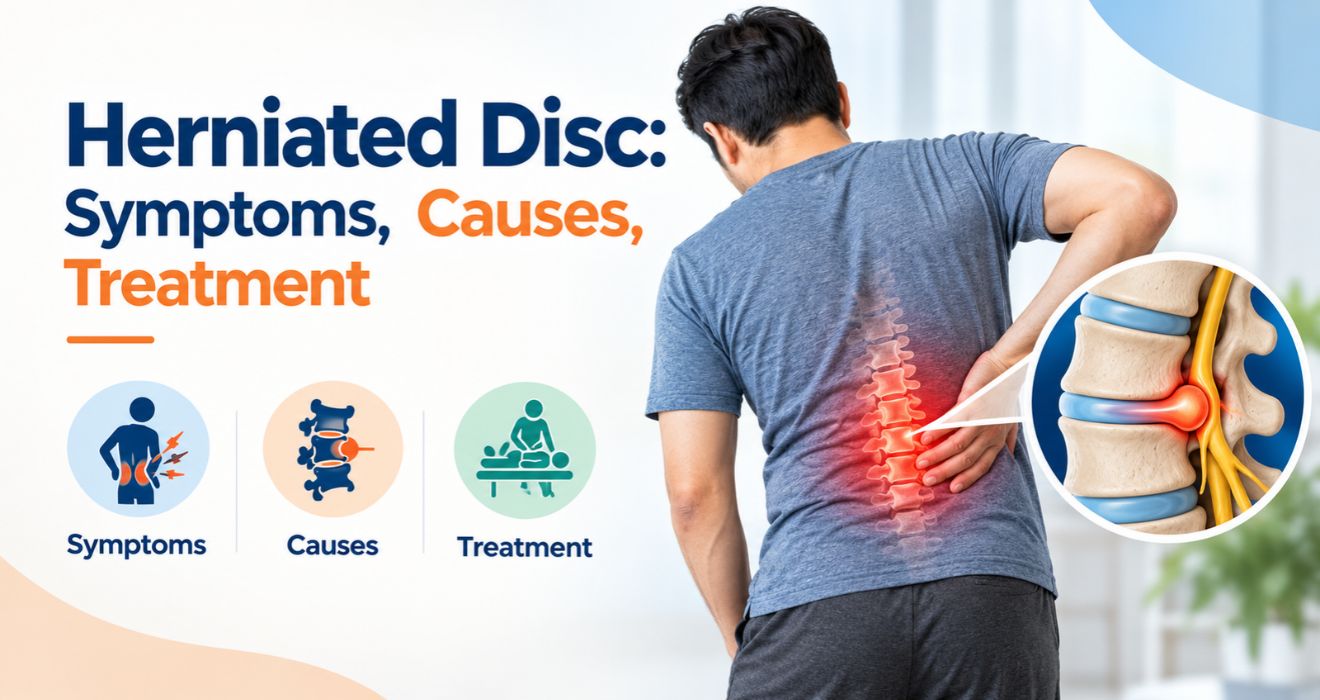
Herniated Disc: Symptoms, Causes, Treatment
What is a Herniated Disc?
At Alpha Ortho Clinic, we often hear from patients who have lower back pain, pain going down the leg, numbness, or tingling. Some patients also tell us, “I can’t bend properly or sleep comfortably because of the pain.”
These symptoms may be related to a herniated disc, also known as a slipped disc or disc bulge.
A herniated disc happens when the soft, jelly-like material inside a spinal disc pushes out through a weak or damaged outer layer. Spinal discs are present between the bones of your spine (vertebrae). When a disc presses on a nearby nerve, it can cause symptoms like sciatica, pain, weakness, tingling, and numbness in the legs.
What are the Symptoms of Herniated Disc?
Most herniated discs happen in the lower back, but they can also occur in the neck. The symptoms can be different depending on where the herniated disc is and whether it is pressing on a nearby nerve. In many cases, the symptoms are felt on one side of the body.
Symptoms of a Herniated Disc :
1. Pain in the Back, Arms or Legs
- Lower Back Herniation: If the herniated disc is in your lower back, you may feel pain that starts in the lower back and travels to the buttocks, thigh, calf, or foot. The pain may feel like a sharp pain, burning sensation, or deep ache. It may become worse while sitting, bending, coughing, or sneezing.
- Neck Herniation: When a herniated disc occurs in the neck, you may feel pain in the neck, shoulder, arm, or hand. The pain can travel down the arm and may become worse with certain neck movements. Some people describe it as a sharp, burning, or aching pain.
2. Tingling or Numbness
A herniated disc can put pressure on a nearby nerve and cause tingling or numbness. You may feel a pins-and-needles sensation in your arm, hand, leg, or foot. Depending on the nerve affected, these symptoms may make some everyday activities difficult.
3. Muscle Weakness
When a herniated disc affects a nerve that controls certain muscles, it can cause weakness in the affected area. You may find it difficult to lift your foot, hold things properly, walk steadily, or perform some everyday movements. In some cases, you may also feel that your leg or arm is not as strong as it used to be.
What Causes Herniated disc?
A herniated disc can happen when the spinal discs become weak or damaged. As we get older, these discs naturally lose water and flexibility, which can make them more likely to develop small tears or become herniated. However, heavy lifting, sudden injuries, extra body weight, smoking, and family history can also increase the risk of developing a herniated disc.
Here are some common causes and risk factors for a herniated disc:
- Age-related changes: As we get older, the spinal discs can lose water and become less flexible. This can make them more likely to develop small tears or become herniated.
- Heavy lifting: Lifting heavy objects, especially with the wrong posture or technique, can put extra pressure on the discs and may lead to a herniated disc.
- Sudden injury: A fall, accident, or sudden twisting movement can put a lot of stress on the spine and may cause a disc to herniate.
- Extra body weight: Being overweight can put more pressure on the discs, especially in the lower back. Over time, this may increase the risk of disc problems.
- Smoking: Smoking can affect the blood supply to the spinal discs and may speed up disc wear and tear. It can also affect the body’s natural healing process.
- Family history: Some people may be more likely to develop disc problems because of their family history. If close family members have had spine or disc problems, the risk may be higher.
What's the Difference Between a Slipped Disc and a Herniated Disc?
Many patients ask whether a slipped disc and a herniated disc are two different problems. In most cases, they are two names used for the same condition. “Slipped disc” is the common term, while “herniated disc” is the medical term.
A disc is a soft cushion between the bones of your spine. When the soft part inside the disc pushes out through a weak or damaged area, it can press on a nearby nerve. This may cause back pain, pain in the leg or arm, tingling, numbness, or weakness.
So, if you have been told that you have a slipped disc, there is usually no need to worry about the different name. Your doctor may use the term herniated disc to describe the same disc problem.
How to Prevent a Herniated Disc?
A herniated disc cannot always be prevented, especially when it happens because of age-related changes in the spine. However, taking care of your back, staying active, and following healthy habits can help lower the risk of disc problems.
1. Stay Active and Exercise Regularly
Regular exercise helps keep the muscles around your back and stomach strong. Strong muscles give better support to your spine and can reduce extra stress on the discs.
Choose exercises that are comfortable for you and avoid sudden or heavy movements that put too much pressure on your back. If you are starting a new exercise routine or already have back pain, it is better to take guidance from a physiotherapist or spine specialist.
2. Maintain Good Posture
The way you sit, stand, and lift things can affect your back. Try to sit with your back supported and avoid bending or slouching for long periods.
If you work at a desk, keep your screen at a comfortable height and take short breaks to stand and walk around. When lifting something heavy, bend your knees, keep the object close to your body, and avoid twisting your back.
3. Maintain a Healthy Weight
Extra body weight can put more stress on the spine, especially the lower back. Maintaining a healthy weight through regular activity and a balanced diet can help reduce this extra pressure and support your overall spine health.
4. Avoid Smoking
Smoking can affect the health of your spinal discs and may speed up the wear and tear that happens over time. Avoiding smoking can help protect your spine and support your overall health.
Small changes in your daily routine can go a long way in keeping your back healthy. Staying active, using the right posture, and taking care of your overall health can help reduce the chances of developing disc problems.
How is a Herniated Disc / Slip Disc Treated?
One of the most common questions we hear from patients with a herniated disc is, “Will I need surgery?” In most cases, surgery is not the first treatment option. A spine specialist will recommend treatment based on your symptoms, the severity of the problem, and how much it is affecting your daily activities.
In many cases, a herniated disc can improve with non-surgical methods. The main aim is to reduce pain, improve movement, and help you get back to your normal routine.
1. Herniated / Slip Disc can be Treated with Non Surgical Treatment
In our experience, many patients with a herniated disc can improve with non-surgical treatment. The treatment depends on the severity of the problem, the symptoms, and how much it is affecting your daily routine.
- Medications: We may recommend medicines to help reduce pain, inflammation, and muscle stiffness. The type of medicine depends on your symptoms and overall condition.
- Physiotherapy Treatment: Physiotherapy is an important part of recovery. Specific exercises can strengthen the back and core muscles, improve flexibility, and reduce stress on the spine. We also guide patients on the right exercises and movements to avoid putting extra pressure on the affected disc.
- Lifestyle Modifications: We often advise patients to make simple changes in their daily routine. Maintaining good posture, sitting correctly, avoiding heavy lifting, and using the right technique while lifting can help prevent the symptoms from getting worse.
- Spinal Injections: If pain continues even after medicines and physiotherapy treatment, we may consider spinal injections such as nerve root injections. These injections can help reduce inflammation around the affected nerve and provide pain relief.
2. Surgical Treatment
Sometimes, surgery may be recommended when severe pain does not improve with non-surgical treatment or when a herniated disc is putting significant pressure on a nerve. Symptoms such as persistent pain, numbness, weakness, or difficulty walking may require further evaluation by a spine specialist.
If surgery is recommended, choosing an experienced best spine surgeon in Mumbai can help you understand your treatment options and what to expect from the procedure. Our spine specialist will assess your symptoms, scan reports, and overall spine condition before deciding whether surgery is needed.
Depending on your condition, different surgical procedures may be considered:
- Microdiscectomy: In this minimally invasive procedure, the part of the herniated disc pressing on the nerve is removed. It may help relieve persistent pain, numbness, or weakness caused by nerve compression.
- Decompression Surgery: This surgery helps relieve pressure on the spinal nerves or spinal cord. It may be recommended when nerve compression continues despite non-surgical treatment.
- Spinal Fusion: When the spine is unstable or needs additional support, spinal fusion may be considered. Screws, rods, or other implants may be used to keep the spine stable while the bones heal.
- Disc Replacement: In selected patients, the damaged disc may be removed and replaced with an artificial disc. The aim is to maintain movement between the vertebrae while treating the damaged disc.
Depending on the location and severity of the problem, other techniques such as endoscopic spine surgery, TLIF, PLIF, ALIF, or minimally invasive spinal procedures may also be considered.
The right surgical approach is different for every patient. Our best spine specialist will explain the suitable option after evaluating your symptoms, scans, and overall spine health.
When to See a Herniated Disc Doctor
Many patients come to us with back pain and wait for it to settle on its own. Sometimes the pain improves with rest and physiotherapy. But if the pain is getting worse or you are having numbness, tingling or weakness, it is better to get it checked by a spine specialist.
You should consult a spine specialist if you have:
- Back or neck pain that is not improving: Pain that continues for a few weeks or keeps getting worse should be evaluated.
- Pain going down the leg or arm: If pain starts in the back and travels into the buttock and leg, or from the neck into the arm, it may be due to pressure on a nerve.
- Numbness or tingling: Feeling pins and needles or numbness in the leg, foot, arm or hand can happen when a nerve is affected.
- Weakness in the arm or leg: Difficulty walking, lifting your foot, holding things or using your arm normally can be a sign of nerve weakness.
- Bladder or bowel problems: Loss of control over your bladder or bowel is a serious warning sign and needs immediate medical attention.
- Difficulty doing your normal activities: If pain or stiffness is making it difficult to walk, sit, bend or do your daily work, you should get evaluated.
If you have any of these symptoms, a spine specialist can examine you and decide whether you need an MRI or other tests. Based on the condition of the disc and the nerves, the treatment may include medicines, physiotherapy, non-surgical treatment or surgery when required.
Frequently Asked Questions
Is a herniated disc the same as a slipped disc?
Yes, slipped disc and herniated disc are commonly used to describe the same condition. A herniated disc occurs when the soft material inside a spinal disc pushes out through a weak or damaged outer layer. If it presses on a nearby nerve, it can cause back pain, pain going into the leg or arm, numbness, tingling, or weakness.
What are the symptoms of a herniated disc?
The symptoms of a herniated disc depend on the location of the affected disc and whether it is pressing on a nerve. Patients may experience lower back or neck pain, pain travelling into the leg or arm, numbness, tingling, or weakness. Some patients also have difficulty sitting, walking, bending, or doing their normal daily activities.
What causes a slipped disc?
A slipped disc can happen as the discs naturally become weaker and less flexible with age. Heavy lifting, sudden injury, repeated strain, excess body weight, and smoking can also increase the chances of developing a herniated disc. In some patients, the problem may develop gradually without one specific injury.
Can a herniated disc be treated without surgery?
Yes, surgery is not required for every herniated disc. Depending on the symptoms and severity of the problem, we may first recommend non-surgical methods such as medicines, activity modification, and physiotherapy treatment. The aim is to reduce pain, improve movement, and help the patient return to normal activities.
How does physiotherapy treatment help with a slipped disc?
Physiotherapy treatment can be an important part of herniated disc treatment. Specific exercises can help improve flexibility and strengthen the muscles supporting the spine. We guide patients according to their symptoms because the same exercises are not suitable for every slipped disc patient.
When does a herniated disc need surgery?
We may consider surgery when pain continues despite non-surgical methods, or when the herniated disc is causing significant nerve compression, weakness, or difficulty walking. Loss of bladder or bowel control is a serious warning sign and needs immediate medical attention. A spine specialist will assess the symptoms and scan reports before recommending surgery.
How long does it take to recover from a slipped disc?
Recovery from a slipped disc is different for every patient. Some patients start feeling better within a few weeks with the right treatment, while others may need more time. The recovery depends on the severity of the disc problem, nerve involvement, and how the patient responds to treatment.
Can a herniated disc happen in the neck?
Yes, a herniated disc can also occur in the neck. When a cervical disc presses on a nerve, patients may have neck pain that travels to the shoulder, arm, or hand. Numbness, tingling, or weakness in the arm or hand can also occur. A spine specialist can assess whether the symptoms are related to a neck disc problem.
When should I see a spine specialist for a slipped disc?
If your back or neck pain is not improving, keeps getting worse, or is associated with numbness, tingling, or weakness, we recommend getting evaluated by a spine specialist. We first understand your symptoms and examine you, and an MRI or other investigation may be advised if required.
What is the best treatment for a herniated disc?
There is no single treatment that is suitable for every patient with a herniated disc. We first look at the symptoms, examination findings, and scan reports before deciding on treatment. Depending on the condition, herniated disc treatment may include medicines, physiotherapy treatment, other non-surgical methods, or surgery when required.
Should I consult a spine specialist for a slipped disc?
If you have persistent pain, pain going down your arm or leg, numbness, tingling, or weakness, it is better not to ignore the symptoms. A spine specialist can check whether the disc is pressing on a nerve and guide you about the right treatment. If you are looking for a best spine surgeon in Mumbai, you can consult our spine team for a detailed evaluation and treatment guidance.
Can a slipped disc come back after treatment?
Yes, symptoms can sometimes return after treatment, especially if the spine continues to be exposed to heavy lifting, poor posture, or repeated strain. We usually advise patients to follow the exercises given during physiotherapy treatment, maintain good posture, and take care while lifting heavy objects. These simple steps can help keep the spine healthy and reduce the risk of further problems.
Need Treatment for a Herniated Disc?
If you are dealing with back or neck pain, pain going into your arm or leg, numbness, tingling, or weakness, do not keep waiting for the symptoms to settle on their own. Consult a spine specialist to understand what is causing the problem and whether you need medicines, physiotherapy treatment, non-surgical methods, or surgery.
Book a consultation with our spine team for a proper evaluation and to understand the treatment options available for your slipped or herniated disc.