

Why Does Shoulder Pain Get Worse at Night? Causes, Relief & Treatment
Have you ever felt that your shoulder is manageable during the day, but the moment you lie down, the pain suddenly becomes more noticeable?
Shoulder pain that gets worse at night is common, but it should not always be blamed on a bad sleeping position. The way you sleep can put pressure on an already irritated shoulder, while conditions such as rotator cuff problems, bursitis, frozen shoulder and arthritis can also cause pain that becomes more troublesome at night.
So, why does shoulder pain get worse at night? In many cases, it is a combination of pressure on the shoulder, prolonged positioning, inflammation and the way the brain perceives pain when there are fewer daytime distractions.
Understanding the reason behind the pain can help you decide whether a simple change in sleeping position is enough or whether you should see an orthopedic specialist.
Why Does Shoulder Pain Get Worse at Night?
There is no single explanation for night time shoulder pain. Several factors can make an existing shoulder problem feel worse after you go to bed.
1. Sleeping on the painful shoulder
This is one of the simplest reasons.
When you sleep on the affected side, your body weight puts continuous pressure on the shoulder joint and the surrounding soft tissues. If the tendons, bursa or joint capsule are already irritated, several hours of pressure can make the pain worse.
Some people also change positions while sleeping without realizing it and end up lying on the painful side.
2. Your shoulder stays in one position for longer
During the day, you naturally move your arm and shoulder frequently. At night, the joint may remain in the same position for hours.
This lack of movement can make an already stiff shoulder feel more painful, particularly in conditions such as frozen shoulder.
3. Rotator cuff problems can cause night pain
The rotator cuff is a group of muscles and tendons that helps stabilize and move the shoulder.
Rotator cuff tendinitis, irritation or a tear can cause pain while lifting the arm, reaching overhead or performing certain daily activities. Night pain is also commonly reported with rotator cuff problems.
If you regularly wake up because of shoulder pain, especially after lying on that side, a rotator cuff problem may need to be considered.
4. Bursitis may become painful when you lie down
The shoulder contains small fluid-filled sacs called bursae that help reduce friction between tissues.
When a bursa becomes inflamed, movements such as lifting the arm can become painful. Direct pressure while sleeping may further irritate the area, making the pain more noticeable at night.
5. Frozen shoulder can disturb sleep
Frozen shoulder, medically known as adhesive capsulitis, causes pain and progressive stiffness in the shoulder.
A person may notice difficulty reaching behind the back, lifting the arm or putting on clothes. Nighttime pain is particularly common during the painful stage, and sleeping comfortably can become difficult.
If your shoulder is becoming increasingly stiff along with nighttime pain, it is worth getting the cause assessed rather than simply changing your pillow or sleeping position.
6. Arthritis and other joint problems
Wear and tear in the shoulder joint can also cause aching, stiffness and pain that may continue into the night.
However, shoulder pain does not always originate from the shoulder joint itself. Problems in the neck can sometimes cause pain that travels toward the shoulder or arm.
That is why identifying the actual source of pain is important before starting treatment.
Why Does Shoulder Pain Feel Worse When You Lie Down?
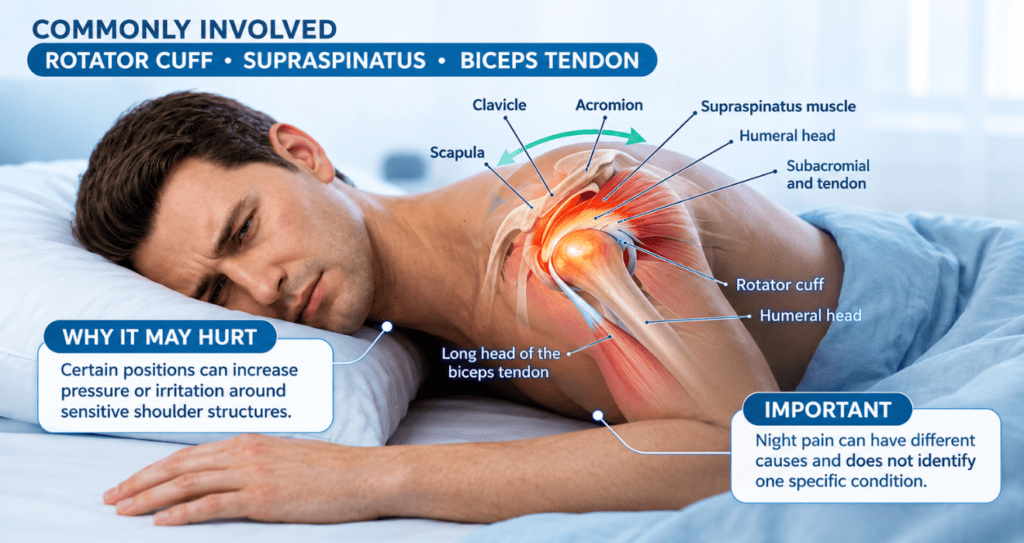
Many people notice that their shoulder feels relatively comfortable while they are busy during the day but starts hurting once they get into bed.
One reason is simply that there are fewer distractions at night. When the surroundings become quiet and you stop moving around, you may become much more aware of discomfort.
Position also matters. Lying on the affected shoulder can compress sensitive tissues, while certain positions can place additional tension on the tendons and joint structures. These factors can make an existing shoulder condition more noticeable.
Research and clinical guidance also suggest that the exact reason for nighttime worsening is not completely understood and may involve several factors rather than one specific mechanism.
How Should You Sleep With Shoulder Pain?
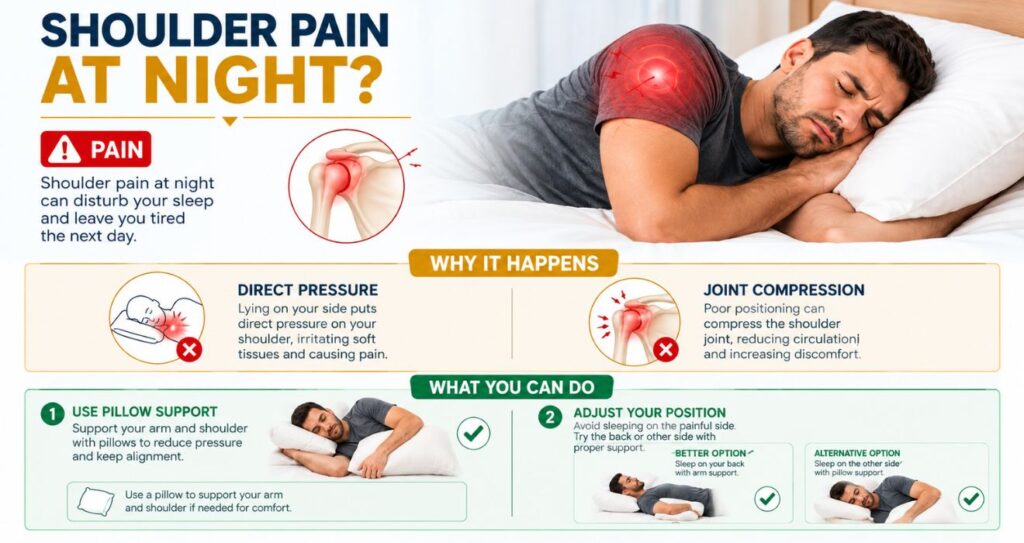
Changing your sleeping position may reduce pressure on the painful shoulder.
Try these simple adjustments:
- Avoid sleeping directly on the painful shoulder.
- If you sleep on your side, try sleeping on the opposite side.
- Place a pillow under or around the affected arm for additional support.
- If sleeping on your back is comfortable, keep the painful arm supported with a pillow.
- Avoid positions that force your shoulder into an uncomfortable angle.
- Give your shoulder enough rest if certain activities are clearly increasing the pain.
These steps may help with comfort, but they do not treat the underlying cause if you have an ongoing shoulder problem.
What Can You Do for Shoulder Pain at Night?
If the pain is mild and has started recently, reducing activities that aggravate the shoulder and using an appropriate cold or warm application may provide temporary relief.
Over-the-counter pain medication may also help some people, but it is not suitable for everyone. Your medical history, other medicines and the cause of the pain should be considered before using medication regularly.
Most importantly, don’t continue pushing through pain if it keeps returning every night.
Persistent nighttime pain can be a reason to have the shoulder examined by an orthopedic specialist. Depending on your symptoms, the doctor may assess your shoulder movement and strength and may recommend imaging such as an X-ray, ultrasound or MRI when required.
When Should You See an Orthopedic Doctor?
You should consider an orthopedic consultation if:
- Shoulder pain keeps waking you up at night.
- The pain has continued for several days or weeks.
- You have difficulty lifting your arm.
- Your shoulder is becoming stiff.
- You notice weakness in the arm or shoulder.
- Pain started after a fall, sports injury or sudden movement.
- You cannot perform normal daily activities because of the pain.
- The pain is getting progressively worse despite rest.
Severe pain after an injury, significant swelling or bruising, sudden weakness, or symptoms extending into the chest, jaw or arm may require quick medical attention rather than waiting for routine treatment.
How Is Shoulder Pain Treated?
Treatment depends on what is actually causing the shoulder pain.
For some conditions, treatment may involve activity modification, physiotherapy and medicines for pain or inflammation. In selected cases, an orthopedic specialist may recommend an injection or other targeted treatment.
If there is a significant rotator cuff tear or another structural problem that does not improve with appropriate non-surgical treatment, surgery may sometimes be considered.
The important point is that shoulder pain treatment should be based on the diagnosis, not just the location of the pain.
For example, treatment for frozen shoulder is not necessarily the same as treatment for a rotator cuff tear or shoulder arthritis. This is why an orthopedic evaluation can be useful when nighttime pain becomes persistent.
Looking for Shoulder Pain Treatment in Mumbai?
If shoulder pain is regularly disturbing your sleep, getting the cause evaluated can help you understand what is actually happening and what treatment options are appropriate.
At Alpha Ortho, patients can consult orthopedic specialists for joint and musculoskeletal problems, including persistent shoulder pain. The Alpha Ortho clinic has multiple locations across Mumbai and Navi Mumbai, including Kandivali, Vile Parle, Vashi, Panvel, Dombivli and Lalbaug, making orthopedic consultation more accessible for patients across different parts of the city.
If you are searching for the best orthopedic surgeon in Mumbai because shoulder pain is affecting your sleep, daily activities or arm movement, focus on finding a specialist who first identifies the cause of the pain and then explains the appropriate treatment options for your condition.
Frequently Asked Questions
Why does shoulder pain get worse at night but feel better during the day?
Night time pain can become more noticeable because you remain in one position for longer, the painful shoulder may be compressed, and there are fewer daytime distractions. Conditions such as rotator cuff problems, bursitis and frozen shoulder can commonly produce this pattern.
Is shoulder pain at night a sign of a rotator cuff tear?
Not necessarily. Rotator cuff irritation or tears can cause nighttime pain, but similar symptoms can occur with bursitis, frozen shoulder, arthritis and other shoulder conditions. A clinical examination is needed to identify the cause.
Which sleeping position is best for shoulder pain?
Avoid putting direct pressure on the painful shoulder. Sleeping on the opposite side with the affected arm supported by a pillow may be more comfortable. Some people also find sleeping on their back with the arm supported helpful.
Can shoulder pain go away on its own?
Some mild shoulder problems improve with rest and appropriate activity modification. However, persistent or worsening pain—particularly pain that repeatedly wakes you at night—should not be ignored.
When should I see a doctor for shoulder pain?
If shoulder pain continues, repeatedly disturbs your sleep, causes stiffness or weakness, limits arm movement, or follows an injury, an orthopedic evaluation is advisable.
Can neck problems cause shoulder pain at night?
Yes. Pain felt around the shoulder does not always originate from the shoulder joint. Certain neck conditions can cause referred pain toward the shoulder or arm, which is why identifying the source of pain is important.